Ancient Vedic Calendar
Abstract: The Vedic Calendar is a pre-modern algorithmic masterpiece that reconciles lunar and solar cycles through elegant mathematical principles. With its epoch at January 21, 4174 BCE (Winter Solstice), it governed India's astronomical reckoning across the Rāmāyaṇa, Mahābhārata, and Buddha's lifetime. Built on a 5-year Yuga cycle using simple integer arithmetic and periodic corrections, the system achieves near-perfect synchronization over 8,610 years (Manvantara) with minimal drift. Its recursive structure, minimalist correction logic, and fractal-like self-similarity demonstrate emergent order from simple rules. This article details the calendar's terminology, structural architecture, intercalation mechanics, and mathematical elegance—a fusion of observation, intuition, and number theory that remains unparalleled in its computational efficiency and long-term stability.
Introduction
The Vedic Calendar represents an ancient Indian timekeeping system of extraordinary precision. Its foundational epoch begins on January 21, 4174 BCE, corresponding to the Winter Solstice, revealed by Svayaṃbhuva Manu (the first Brahmā, c. 3391 BCE). This calendar governed India's astronomical reckoning across the Rāmāyaṇa (birth@ 1331 BCE, war@ 1299 BCE), Mahābhārata (war@ 827 BCE), and Buddha's lifetime (563–483 BCE), continuing at least until the start of the Siddhānta period (~250 CE).
Terminology
Tithi: A Lunar Day Pakṣa: Two halves of the lunar month: Śukla Pakṣa (bright-half) and Kṛṣṇa Pakṣa (dark-half) Māsa: The lunar month Ṛtu: One of the six seasons of the year, generally of two lunar months Ayana: The two halves of a year, North-Half (Uttarāyaṇa) and South-Half (Dakṣiṇāyana) Varṣa: A lunisolar year, consists of 12 or 13 lunar months Yuga: A 5-year period Mahā-Yuga (Greater Yuga): A 120-year or 24-Yuga cycle Manvantara (Age of Manu): An 8,610-year or 71.75 Mahā-Yuga cycle
Structure of the Ancient Lunisolar Calendar
(a) Time Cycles
- Tithi: A Lunar Day, always counted sunrise-to-sunrise, from when the lower edge of the sun is visible on the horizon.
- Pakṣa: Of the two monthly halves, Śukla (bright-half) always comes first, then Kṛṣṇa (dark-half). The true Vedic system is Amānta (New Moon Ending), not Pūrṇimānta (Full Moon Ending). The present North-Indian Pūrṇimānta tradition is a later innovation by Āryabhaṭṭa.
- Māsa: The lunar months always run from New Moon to New Moon, with the Bright-Fortnight always coming first.
- Ṛtu: There are a total of six seasons starting from the first month, in groups of 2 lunar months; the third and sixth seasons may be of 3 lunar months if there are intercalary months.
- Ayana: The first 6/7 months of the lunisolar year, including the intercalary month if any, are known as Uttarāyaṇa (North-Half) and the remaining 6/7 months are known as Dakṣiṇāyana (South-Half).
- Varṣa: Each lunisolar year consists of 12 or 13 lunar months and, without exception, always starts from and ends near the Winter Solstice, like a pendulum swinging around its mean position.
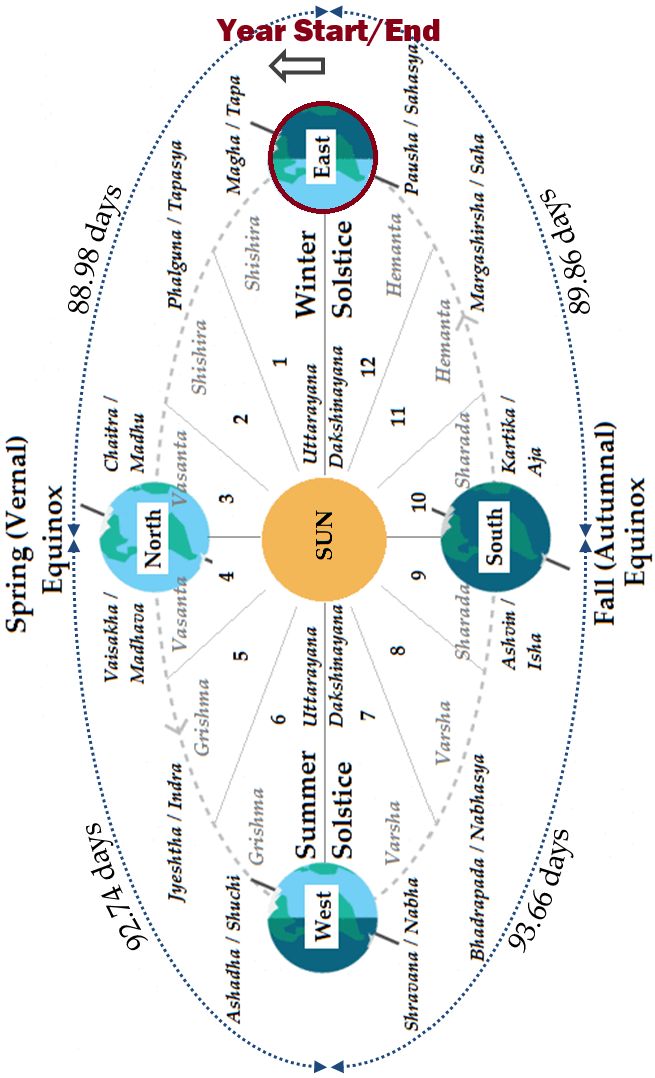
- Yuga: Each Yuga lasts 5 years (61 or 62 lunar months), as stated in the Mahābhārata and Vedāṅga-Jyotiṣa. Its five years are named: Saṃvatsara, Parivatsara, Idvatsara, Anuvatsara, and Vatsara.
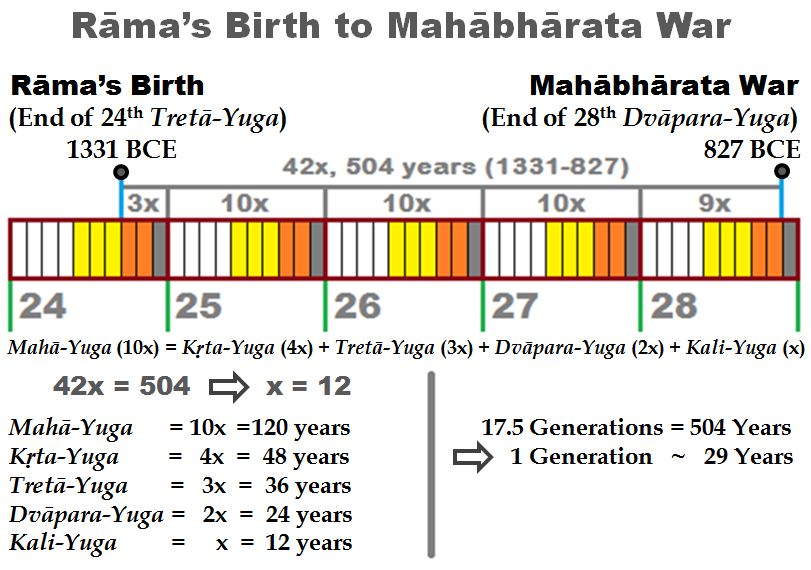
- Mahā-Yuga: Every Mahā-Yuga consists of 24 Yugas, totaling 120 years. It divides into four Dharma-Yugas in consistent order:
- Satya-Yuga: 48 years
- Tretā-Yuga: 36 years
- Dvāpara-Yuga: 24 years
- Kali-Yuga: 12 years
For example: King Rāma's birth occurred in the last year of the 24th Tretā-Yuga (1331 BCE), and the Mahābhārata War occurred in the last year of the 28th Dvāpara-Yuga (827 BCE), as can be verified from their horoscopes in the App.
- Manvantara: A Manvantara (Age of Manu) spans exactly 8,610 years or exactly 71.75 Mahā-Yugas, for which it's stated in the Purāṇic texts that "it's more than 71 but a little less than 72". The current Age of Manu (Manvantara) began on BCE 4174/01/21 at 06:32:00 UTC.
(b) Intercalation Mechanics
Within every five Mahā-Yugas (120 Yugas / 600 years / 7,421 lunar months), intercalary months follow a precise pattern:
- General-Yuga (most Yugas): 62 lunar months with 2 intercalary months - one in the middle of year 3, another at the end of year 5
- Special-Yuga (every 6th): 61 lunar months - the final intercalary month is omitted
- Superspecial-Yuga (60th only): Exception - retains 62 months despite being a Special-Yuga
These simple rules maintain harmony between the solar year (365.243 days) and lunar month (29.530 days) across millennia — no leap years, no Gregorian-style reform, no drift over thousands of years.
Lunar Month Structure
Tithi (Lunar Day): A lunar day is counted from sunrise to sunrise, when the sun has finished rising. There are 13 to 16 Tithis in every month and there is never a "Kṣaya" (omitted) Tithi.
Māsa (Lunar Month): Months always run from New Moon to New Moon. They begin with the first day of Śukla Pakṣa (bright-half), followed by Kṛṣṇa Pakṣa (dark-half).
New Moons: New Moons (Amāvasyā) always occur towards the end of the month. The New Moon Day (Amāvasyā) is determined by the New Moon Point (NMP):
- If the NMP occurs before local midday, that day is Amāvasyā, and the next day starts the new month.
- Otherwise, the following day becomes Amāvasyā, and the subsequent day begins the new month.
Full Moons: Full Moons (Pūrṇimā) always occur near the middle of the month. The Full Moon Day (Pūrṇimā) is determined by the Full Moon Point (FMP):
- If FMP occurs before local midday, that day is Pūrṇimā, and the next day starts Kṛṣṇa Pakṣa.
- Otherwise, the following day is Pūrṇimā, and the subsequent day begins Kṛṣṇa Pakṣa.
The Mathematical Beauty of the System
The Vedic Calendar is not merely a collection of rules — it's a compact, elegant mathematical system that reconciles lunar and solar cycles using simple integer arithmetic and periodic corrections. It stands apart from all later calendars (Greek, Roman, or even Julian–Gregorian) because it's built entirely on rational-number synchronization. Below is why it stands as an intellectual triumph:
1. Closed, Recursive Structure
The system is a self-contained cyclic algorithm — every Yuga, Mahā-Yuga, and Manvantara fits into the next with fractional-day precision. Each Yuga contributes a constant offset (+4.68144 days) which is corrected through simple integer rules (drop a month every 6 Yugas, restore at 60th). Over higher orders (120 Yuga cycles and Manvantaras), these corrections compose to nearly exact resets. After every 1722 Yugā = 8610 years, the winter-solstice and new-moon points return to near-perfect alignment (offset ≈ –0.36 days). That is 8 millennia of perfect synchronization — achieved with only integer rules and a constant.
2. Minimalist Correction Logic
Only two local rules maintain great harmony between the solar year (365.243 days) and lunar month (29.530 days) indefinitely:
- Drop one lunar month every 6 Yugas.
- Add one lunar month every 60 Yugas (exception at 120th cycle).
This is an instance of emergent order from simple rules — a hallmark of mathematical beauty.
3. Integer and Fractional Harmony
The calendar mixes integer counts (Yuga numbers, adjustments) with a single fractional constant (4.68144 days). This pairing allows exact modular arithmetic (quotients, floors) to produce predictable fractional phase shifts. Modern number theory recognizes such constructs as efficient methods for synchronization of incommensurate periods.
4. Fractal-Like Self-Similarity
Each scale (Yuga → Mahā-Yuga → Manvantara) behaves like a scaled copy of the smaller scales, with the same correction logic applied iteratively. Each level is self-similar: > Every 5 years (Yuga) ≈ lunisolar drag reconciliation > Every 30 years (6 Yugā) ≈ lunisolar drift reconciliation > Middle of every 600 years (120 Yugā) ≈ lunisolar drag reconciliation > Every 8610 years (Manvantara) ≈ complete reset
5. Empirical Precision
Despite being conceptualized millennia ago, the mean-value predictions stay within approximately one day of modern ephemerides across thousands of years. That implies a drift of a few seconds per year — a remarkable fidelity for a pre-modern computational system.
6. Predictive and Computable
Every date can be calculated using only arithmetic — no observations required for the bulk calculation. This computational advantage allowed ancient priests and astronomers to construct long-term almanacs by hand.
7. Elegance Over Complexity
Contrast this with later approaches that introduced ad-hoc corrections, leap rules, or iterative recalibrations. The Vedic method is lean: few primitives, clear hierarchical rules, and demonstrable long-term stability. This gives it both aesthetic and practical superiority.
Final Thought
The Vedic Calendar is a pre-modern algorithmic masterpiece. It demonstrates that early astronomers understood how to encode long-term astronomical periodicities into compact mathematical rules — a fusion of observation, intuition, and number theory that still inspires admiration today.
References & Notes
- "The Science of Time and Timeline of World History", 2017