Nakṣatra Zodiac & Sūrya Siddhānta - Analysis, Verification, and Implications
Abstract - This article examines the original Nakṣatra-based reckoning used in classical Indian astronomy and how it relates to the 12‑sign (tropical) Zodiac. It shows that the commonly held equivalence "Aśvinī 0° = Aries 0°" is incorrect: the correct equivalence used in early Siddhānta tradition places Aries 0° at the start of the second quarter of Aśvinī, i.e. Aśvinī 3°20′ = Aries 0°. The mismatch arose in the early medieval period and was propagated thereafter; re‑examining methods found in Karaṇasāra and Al‑Bīrūnī's reports supports restoring the Nakṣatra Zodiac back by a quarter‑nakṣatra (3°20′).
1. The Core Claim
The standard modern assumption that Aśvinī 0° ≡ Aries 0° is historically and textually unsound. Classical Siddhānta texts (for example the Sūrya Siddhānta) used Aśvinī 0° as their internal reckoning point, not Aries 0°. The correct mapping used in older Indian practice - supported by calculations and medieval reports - is that Aries 0° corresponds to Aśvinī 3°20′ (i.e. the second quarter of Aśvinī).
A misreading around ~600 CE - found in some Indian and Muslim astronomers' work and repeated later by authors influenced by Ujjain traditions - re-centered Aries 0° at Aśvinī 0°, shifting the entire Nakṣatra Zodiac forward by one quarter nakṣatra (3°20′). Al‑Bīrūnī's notes (and Varāhamihira's statements) reflect the alternative (and later) convention that led to widespread confusion: for example, Al‑Bīrūnī interpreted Maghā 0° ≡ Leo 0°, which is consistent with the shifted convention (and implies Aśvinī 0° ≡ Aries 0°).
2. Karaṇasāra Method and Al‑Bīrūnī's Report - Arithmetic Verification
Al‑Bīrūnī records astronomical data and an applied algorithm (attributed to the Karaṇasāra tradition) used to compute the position of the Great Bear (Saptaṛṣi). The method quoted in the sources is:
> Subtract 821 from the Śaka‑kāla (Śaka year). Multiply the remainder by 47, add 68,000, and divide the sum by 10,000. The quotient gives the zodiacal signs and fractions (from Aries) for the Saptaṛṣi position.
We verify two illustrative instances mentioned in the sources to confirm the implied Nakṣatra ↔ sign mapping.
2.1 Al‑Bīrūnī's Epoch (1031 CE)
- Convert to Śaka era: 1031 CE − 78 = 953 Śaka (Śaka era starts 78 CE).
- Apply Karaṇasāra basis: 953 − 821 = 132.
- Compute: (132 × 47 + 68,000) / 10,000 = 7.4204 signs from Aries.
- The fractional part 0.4204 × 30° = 12.611999...° = 12°36′43.2″.
- Thus the Saptaṛṣi longitude computed by this rule for Al‑Bīrūnī's epoch is Scorpio 12°36′43.2″ (since 7 full signs from Aries = start of Scorpio at 210°, plus 12°36′43″).
Al‑Bīrūnī records the Saptaṛṣi location in terms of Nakṣatra fractions (he gives 9°16′43″ of Anurādhā for his reading; and the difference here is exactly 3°20′ - a nakṣatra quarter), and his interpretation is consistent with the shifted convention (Maghā 0° ≡ Leo 0°) that he appears to have adopted. The Karaṇasāra computation above confirms the internal numerical consistency of Al‑Bīrūnī's report under his adopted convention.
2.2 Saptaṛṣi‑Movement Observation (Al‑Bīrūnī quoting Kashmir Almanacs)
Al‑Bīrūnī also quotes a Kashmiri almanac stating that, in Śaka 951, the Saptaṛṣi "have stood for 77 years in Anurādhā". It is this observation, combined with the Karaṇasāra method, which makes known the true Indian equivalence of the fixed Nakṣatra Zodiac with the movable western Zodiac. Interpreting this:
- If Saptaṛṣi were 77 years into Anurādhā in Saka 951, they would have entered its start 77 years earlier → Saka 951 − 77 = 874.
- Karaṇasāra for Saka 874: 874 − 821 = 53 → (53 × 47 + 68,000) / 10,000 = 7.0491 signs from Aries.
- The fractional part 0.0491 × 30° = 1.473° = 1°28′22.8″.
- That is Scorpio 1°28′22.8″ according to the algorithm - very close to the start of Scorpio (Scorpio 0°).
Taken together, the Karaṇasāra result for 874 Śaka and the Saptaṛṣi‑in‑Anurādhā statement indicate that Anurādhā 0° lay at, or very near, Scorpio 0° in the Indian reckoning preserved in regions such as Kashmir up to about 1000 CE. This supports the interpretation that the original Nakṣatra‑to‑sign mapping used by classical Indian astronomers places Aries 0° = Aśvinī 3°20′ (i.e. shift the Nakṣatra Zodiac back by 3°20′ relative to the later, shifted convention).
> Note on approximations: the Karaṇasāra rule and medieval notations use coarse integer arithmetic and epoch conventions; small residuals of order 1°–1.5° are expected. The combined textual + algorithmic evidence supports the quarter‑nakṣatra shift as the historically intended mapping rather than the later Aries‑at‑Aśvinī‑0° convention.
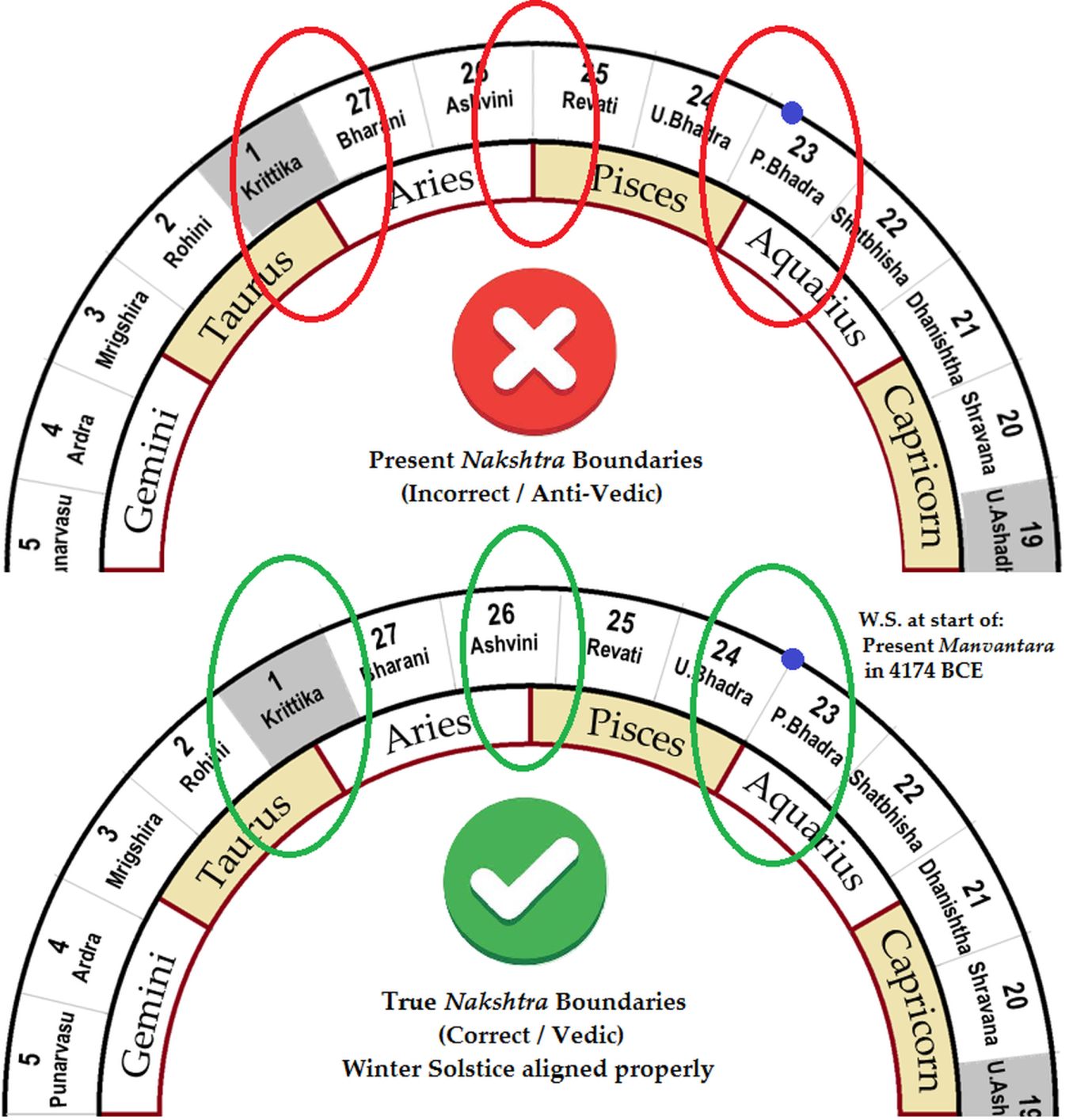
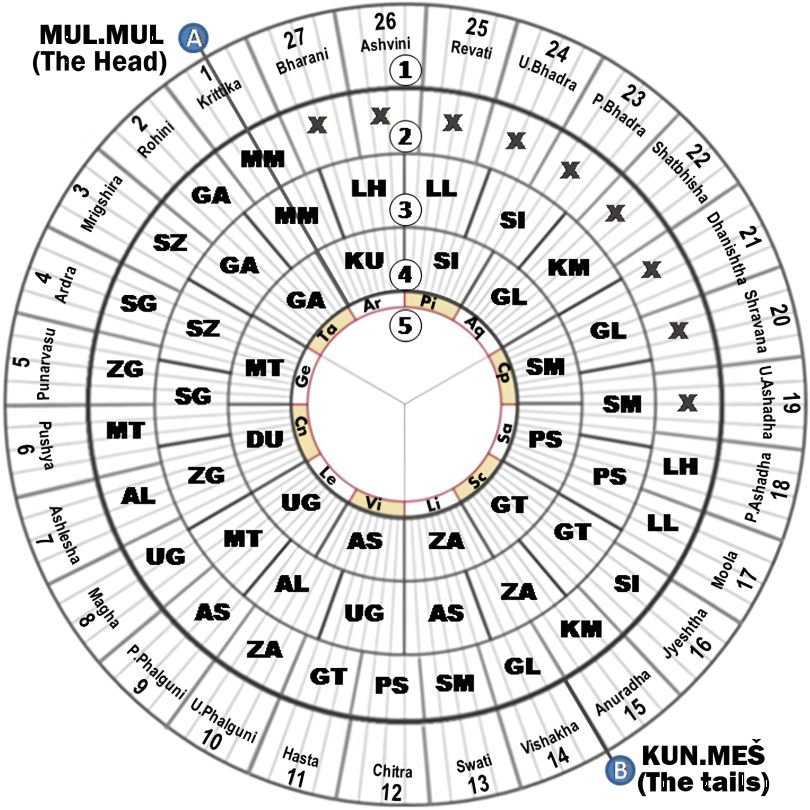
Interestingly, this Aśvinī-based equation (Aśvinī 3°20′ = Aries 0°) mirrors the (MUL.MUL 6°40′ + 180° = KUN.MEŠ 0°) equation from the early Sumerian Zodiac (described in "The Origins of Western Zodiac" article), where the “head” and “tail” of the Zodiac were placed 180° apart. This further reinforces the continuity of astronomical logic across cultures and time.
3. Sūrya Siddhānta Longitudes and the Quarter‑Nakṣatra Correction
The Sūrya Siddhānta provides longitudes for the Yogatārā (chief Nakṣatra stars) measured from Aśvinī 0°. When these longitudes are converted to the 12‑sign Zodiac counted from Aries 0°, they must be reduced by 3°20′ (one quarter nakṣatra) to match the original Siddhāntic intent. In other words:
- SS longitude (from Aśvinī 0°) − 3°20′ ≈ SS longitude from Aries 0°.
Applying this simple shift reconciles many of the apparent mismatches earlier western editors and commentators (e.g., Bentley, Burgess) found when trying to identify the Yogatārā from the Sūrya Siddhānta longitudes. Once the quarter‑nakṣatra correction is applied, the Sūrya Siddhānta longitudes align much better with visible candidate stars (within observational and transmission error bounds).
A representative excerpt of the Sūrya Siddhānta Yogatārā table (full table available in book) shows that most of the listed stars fall within observationally plausible longitudes after subtracting 3°20′. The original source lists 27 Yogatārā (Aśvinī→Revatī) with magnitudes and latitudes; applying the quarter‑nakṣatra correction reduces systematic offsets and explains the otherwise puzzling placements recorded by early editors.
4. Implications and Conclusion
- The historical Nakṣatra Zodiac used in classical Indian astronomy places Aries 0° at Aśvinī 3°20′, not at Aśvinī 0°. The prevalent modern assumption (Aśvinī 0° = Aries 0°) represents a medieval shift and should not be taken as the Siddhāntic default without explicit note.
- Restoring the Nakṣatra Zodiac back by 3°20′ (one quarter nakṣatra) brings Sūrya Siddhānta longitudes and medieval observational reports (as reported by Al‑Biruni and via Karaṇasāra arithmetic) into better concordance.
- Small arithmetic residuals (~1°) are expected given the coarse epoch arithmetic and textual transmission; the qualitative structural correction (quarter‑nakṣatra shift) remains the robust conclusion.
- For practical work (ephemeris reconstruction or Nakṣatra‑based historical astrology), adopt the quarter‑nakṣatra correction when reading pre‑medieval Siddhānta‑style longitudes unless the source explicitly states the later Ujjain/shifted convention.
References & Notes
- "The Science of Time and Timeline of World History", 2017
- Al‑Bīrūnī, India (passages on astronomical observations and Kashmiri almanacs).
- Expositions of the Karaṇasāra method as quoted/used in medieval Indian astronomical literature.
- Sūrya Siddhānta (Yogatārā longitudes).
- Secondary commentary by John Bentley and others on the Sūrya Siddhānta (for comparison of earlier western readings).