Vedic Ayanāṃśa - Formulation, Rationale, and Practical Definition
Abstract - Ayanāṃśa is the angular offset between the fixed (star-based) Zodiac and the movable (equinox-based) Zodiac for any epoch. This article presents a compact, methodical formulation of the Vedic Ayanāṃśa: why a fixed-star anchor is preferred over a linear precession formula, why Asellus Australis (Delta Cancri) is chosen as the anchor, the calibration steps used to fix the star’s longitude, and the final practical definitions (including the adopted intermediate epoch: 20/Oct/187 AD). The treatment follows Vedāṅga Jyotiṣa principles and restores the Nakṣatra boundaries to their fixed-Zodiac locations.
1. Problem Statement - What is Ayanāṃśa?
Ayanāṃśa = (fixed Zodiac longitude) − (tropical/equinox Zodiac longitude). Many existing Ayanāṃśā (e.g., Lahiri, True Citrapakṣa) are effectively conventional - they use arbitrary reference choices (for example, fixing Aries 0° relative to Spica) rather than an observationally robust anchor. That arbitrariness limits precision and historical fidelity.
2. Two Computational Approaches - Pros & Cons
1. Linear precession model (y = a·x + b)
- Uses a constant precession rate to extrapolate Ayanāṃśa.
- Problem: Precession rate is not strictly constant - it accelerates and decelerates due to long-term dynamical effects; a constant rate yields secular errors over millennia.
2. Fixed-star anchor method (recommended)
- Choose a physically stable, observable star near the ecliptic as the fixed Zodiac anchor.
- Anchor the fixed Zodiac to that star’s (corrected) longitude; compute Ayanāṃśa epoch-wise from the star-anchored fixed Zodiac.
- Advantage: removes direct dependence on an assumed constant precession rate; relies on stellar positions that are quasi-fixed relative to each other.
3. Criteria and Selection of an Anchor Star
A suitable anchor must:
- Lie close to the ecliptic (so its longitude is a good marker for Zodiac boundaries).
- Exhibit minimal longitudinal proper motion when sampled over multi-millennial intervals.
Programmatic checks identify Asellus Australis (Delta Cancri) as uniquely suitable among commonly used zodiacal stars: it is near the ecliptic, visible to the naked eye (mag ≈ 3.94), and shows minimal longitudinal drift over the sampling intervals used. Hence Asellus Australis becomes the Vedic Zodiac anchor star.
4. Calibration Procedure
1. Select an ancient base epoch for aligning seasonal points (winter solstice / vernal equinox). In the Vedic formulation this base solstitial epoch remains the deep-antiquity anchor (the treatment traditionally centers on winter solstice of the Manvantara start), while an intermediate fixed-zero epoch is explicitly adopted for intermediate epoching: 20/Oct/187 AD. 2. Compute the tropical (equinox) position of the Sun at the chosen base solstice using a tropic/ephemeris model and compare it with the fixed-Zodiac position given by an existing Ayanāṃśa (e.g., True Citrapakṣa). 3. Any angular discrepancy between the winter solstice’s fixed-Zodiac longitude and the desired canonical value (Pisces 0° for the chosen base) is taken as a correction and applied to the anchor star’s longitude. 4. Iterate once to converge: the corrected anchor longitude defines the Vedic Ayanāṃśa; checking the solstice again gives residuals close to zero.
Using the method above (as worked out in the Vedic treatment), the fully corrected fixed longitude of Asellus Australis becomes:
> Asellus Australis (Delta Cancri) - fixed Zodiac longitude: 103° 29′ 32.9375″ (i.e., 103.4924826488°)
After this calibration, the winter-solstice at the ancient base epoch reads effectively Pisces 0° to within arc-seconds.
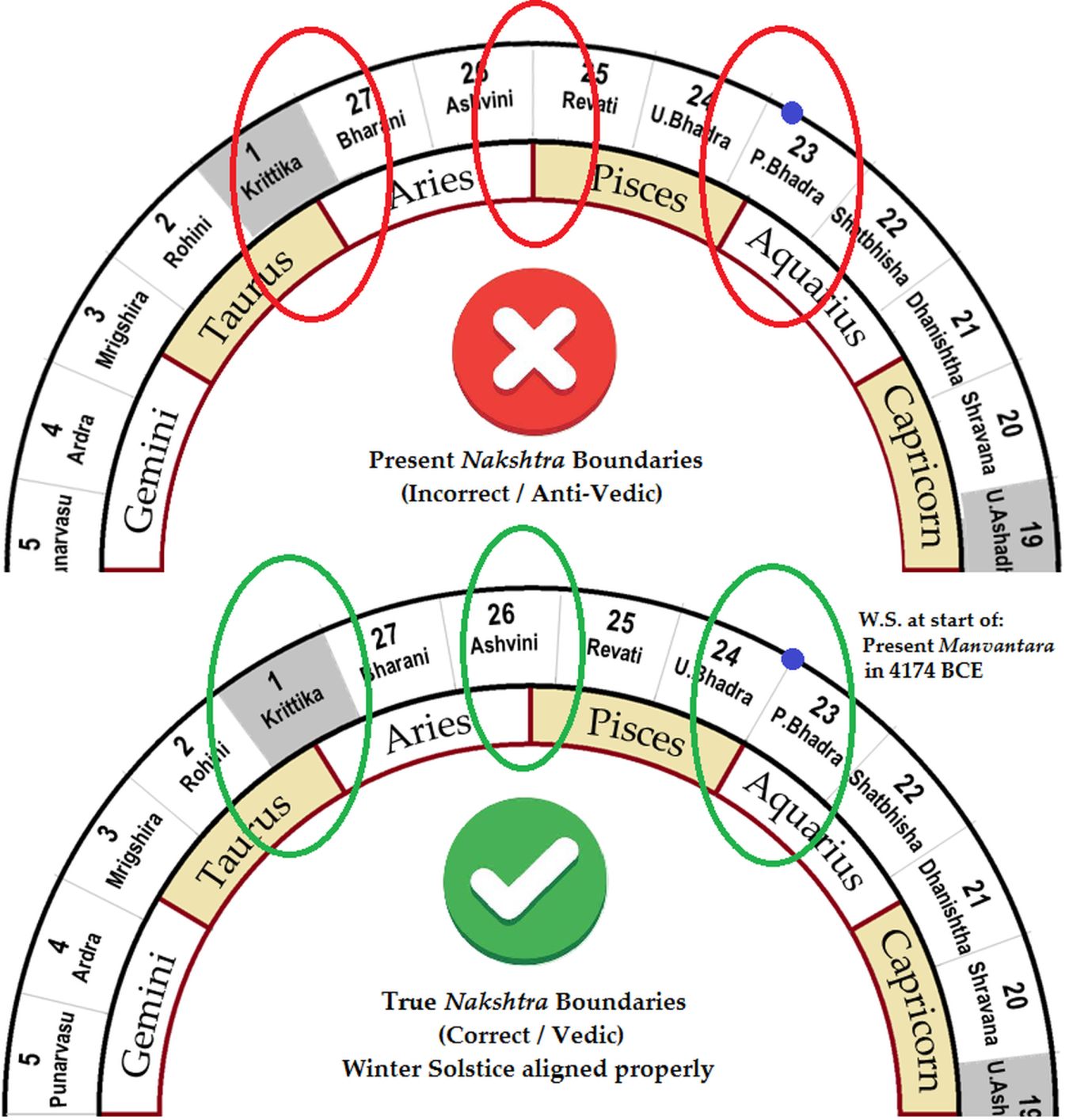
5. Nakṣatra Boundary Consequences
- With the corrected anchor longitude, Āśleṣā (7th Nakṣatra) is fixed to start at Cancer 13°20′ in the fixed Zodiac.
- Asellus Australis therefore sits at 13°29′32.9375″ of Cancer (i.e., just after the end of Puṣya), and functions as the practical Nakṣatra marker for Āśleṣā.
- Restoring Nakṣatra boundaries to these fixed positions preserves the planetary-to-Nakṣatra relationships expected from Vedāṅga Jyotiṣa and from the horoscopic records of epic periods.
6. Ayanāṃśa Quick Estimation Rule
A simple approximate computation (useful for quick checks, not as a substitute for ephemeris calculations) is to use the average long-term rate implied by the Manvantara cycle: divide elapsed years by 71.75 (years per degree approximation from the Manvantara scheme). If one prefers a single-step intermediate epoch, count the years from the chosen fixed-zero intermediate epoch (20/Oct/187 AD) and divide by 71.75 to get an approximate Ayanāṃśa (degrees). This gives fast, order-of-magnitude values but should be validated against proper ephemerides for precision work.
7. Why this Vedic Ayanāṃśa matters
- It replaces arbitrary conventions by an observationally anchored definition consistent with Vedāṅga principles.
- It restores Nakṣatra boundaries in a way that keeps planetary placements in the Nakṣatra framework coherent for Vedic and epic-era horoscopes.
- By anchoring to a physical star, the method keeps the computation robust against simple constant-rate precession errors and gives a transparent, reproducible epoching procedure.
Key Numbers (Summary)
- Fixed-zero (intermediate) epoch used for calibration: 20/Oct/187 AD (This is actual computational value rather than the ideal value of 132 AD provided in the book which should have been the case if the middle of Manvantara aligned perfectly with Aries 0° as it ideally should have been)
- Anchor star: Asellus Australis (Delta Cancri) - visible, mag ≈ 3.94
- Final fixed longitude (Asellus Australis): 103° 29′ 32.9375″
- Start of Āśleṣā Nakṣatra (fixed Zodiac): Cancer 13° 20′
References & Notes
- "The Science of Time and Timeline of World History", 2017