The Origins of Western Zodiac
Abstract - It is a common misconception in the West that Indian astronomy originated from the Greeks - a fallacy akin to mistaking one's great-great-grandfather for a junior. A closer comparative analysis of the Mesopotamian (Sumerian and Babylonian) Zodiacs, the 12-sign modern Western Zodiac, and the Vedic Zodiac clearly establishes that the modern Western Zodiac is, in fact, a fifth-generation devolution of the original Vedic Zodiac, which is based on 27 Nakṣatras (lunar mansions). Let's dive in.
The Sumerian Zodiacs
Among the recovered Mesopotamian texts is an astronomical compilation known as MUL.APIN, found inscribed on baked clay tablets and dated between 1000–686 BCE. This text identifies 18 named lunar stations along the Moon’s path, which has led most scholars to conclude that the Sumerians used an 18-sign Zodiac. However, this conclusion is flawed.
Logically, the Moon’s journey can be divided either into 27 lunar stations (corresponding to the 27 days of a sidereal month) or into 12 stations (aligned with the 12 full moons in a lunar year). The idea of 18 moon-stations lacks any astronomical coherence.
Moreover, the first 9 lunar stations in MUL.APIN, beginning with MUL.MUL (the Pleiades), show a one-to-one correspondence with the first 9 Nakṣatras of the Vedic Zodiac, which also begins with Kṛttikā (Pleiades). These 9 stations together span one-third (120°) of the Zodiacal circle. So, if the Sumerian Zodiac were to have only 18 stations in all, the remaining 9 stations would need to cover the remaining two-thirds (240°), which is clearly disproportionate and illogical.
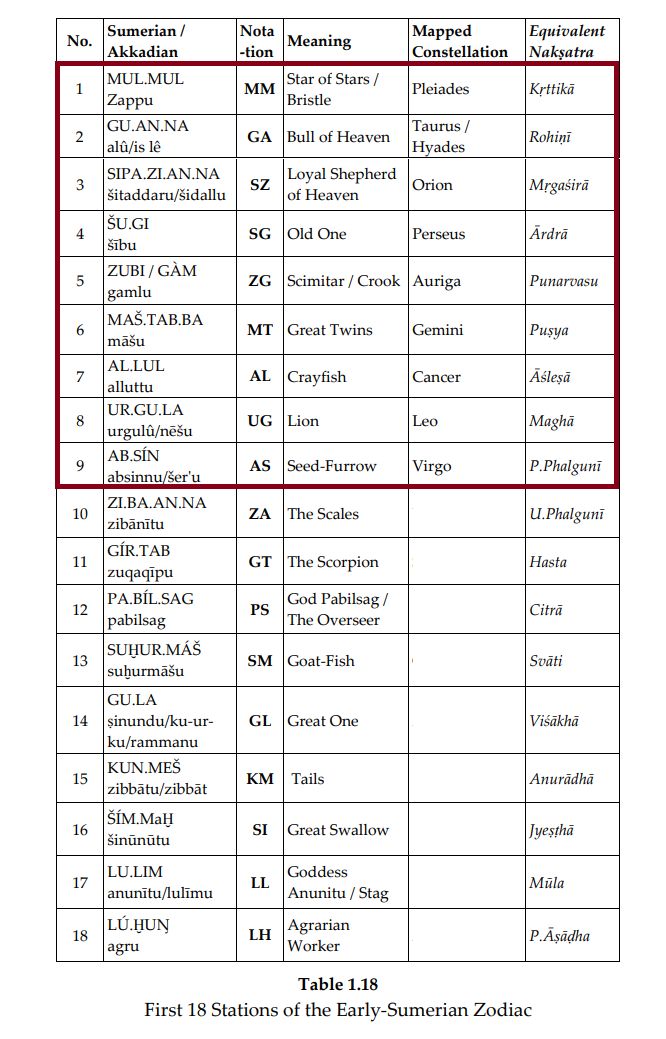
Also telling is the placement of KUN.MEŠ, the 15th lunar station in MUL.APIN, which translates to “the tails.” In a circular system like the Zodiac, if the first station is considered “the head,” then “the tail” should either lie opposite it or adjacent to it - at the end. Placing “the tail” at position 15 out of 18 makes no conceptual sense unless "the tail" lies at 15th position. Which is very much true.
Because, mathematically, the starting point of KUN.MEŠ lies exactly 13.5 stations (or 180°) away from the midpoint of MUL.MUL. This supports the logic of a 27-station system where "the tails" lies diametrically opposite "the head." Thus, it can be confidently concluded that the original Sumerian Zodiac - like the Vedic one - began with MUL.MUL and consisted of 27 lunar stations, each corresponding to one of the Vedic Nakṣatras.
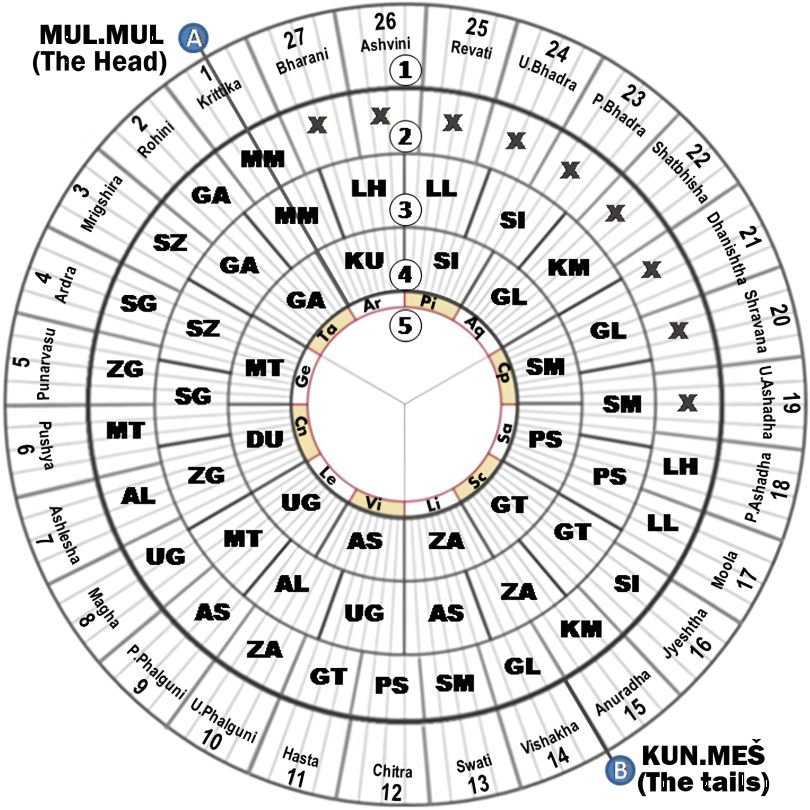
Consequently, MUL.APIN likely describes an incomplete 18-station Late-Sumerian Zodiac, rather than the original 27-station Early-Sumerian version, which may have been forgotten or lost over time.
The Babylonian Zodiac
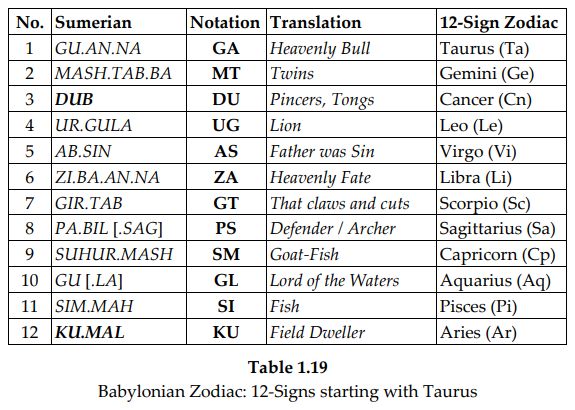
Over time, the incomplete 18-Sign Late-Sumerian system was adopted and further simplified by the Babylonians, who reduced the number of lunar stations from eighteen to twelve - a more coherent model that aligned with the twelve full moons of the lunar year.
Due to this reduction in the total number of stations, their sizes expanded and the starting point shifted from MUL.MUL to GU.AN.NA, the second station in the earlier system. This repositioning aligned the Zodiac’s starting point with the center of the Pleiades - the heart of the now non-existent station of MUL.MUL - which corresponds with modern-day Taurus.
The Greek (Western) Zodiac
Following Alexander the Great’s conquest of Babylon in 321 BCE, the 12-sign Babylonian Zodiac was inherited by the Greeks, who introduced two major changes:
1. The Greek Zodiac became a movable system, defined not by the fixed stations/constellations like the MUL.MUL (Pleiades), but by the ever-shifting vernal equinox. 2. They realigned the Zodiac’s start to the previous sign of Aries (KU.MAL), rather than to the first sign of Taurus (GU.AN.NA) of Babylonian Zodiac, because the vernal equinox of their time fell near the beginning of Aries.
This system - with a movable starting point and 12 signs - eventually became the modern Western Zodiac still in use today.
The Vedic Zodiac
In India, the original 27-Nakṣatra Vedic Zodiac is still widely used. During the Siddhānta period, Indian astronomers were introduced to the 12-sign Greek Zodiac and, unaware of its origins, readily adopted it - believing it to be a novel system.
In their eagerness to integrate it with the Vedic system, they made a small but significant shift: instead of starting from Kṛttikā (Pleiades), the traditional first Nakṣatra, they began their count from the 26th Nakṣatra, Aśvinī, which at the time was closer to the vernal equinox (then around Aries 0°).
This created a quarter-Nakṣatra misalignment, since Aries 0° actually corresponded to Aśvinī 3°20′, not its beginning. This misconception, which introduced a systematic shift in the fixed Zodiac, has persisted to the present day.
Interestingly, this Aśvinī-based equation (Aśvinī 3°20′ = Aries 0°) mirrors the earlier (MUL.MUL 6°40′ + 180° = KUN.MEŠ 0°) equation, where the “head” and “tail” of the Zodiac were placed 180° apart. This further reinforces the continuity of astronomical logic across cultures and time.
Conclusion
So, it can be stated undoubtedly that the 12-sign modern Western Zodiac is factually a fifth-generation devolution of the still-prevalent 27-Nakṣatra Vedic Zodiac. The progression follows these five stages:
1. 27-Nakṣatra Vedic Zodiac 2. 27-Station Early-Sumerian Zodiac 3. 18-Station Late-Sumerian Zodiac 4. 12-Station Babylonian Zodiac 5. 12-Station Greek/Western Zodiac (shifted back by one sign)
References & Notes
- "The Science of Time and Timeline of World History", 2017