Indian Astronomy - Cultural Transmission and the Siddhāntic Revolution
Abstract – Vedic astronomy was originally a precise, observational system centered on Nakṣatra (stellar) divisions rather than computational planetary models. Over time, linguistic loss, cultural transitions, and exchanges with Yavana (Indo‑Greek) regions introduced the 12‑sign Zodiac, epicyclic models, and trigonometric methods into India. This article traces the historical continuum from Vedic observational astronomy through the Yavana‑Śaka interactions to the Siddhānta era, highlighting the formation ...
1. The Vedic Foundation - Observational Precision without Computation
In early Vedic astronomy, planetary positions were observed, not computed. The sages recognized all visible planets and Nakṣatrā precisely, as attested by the accurate sky descriptions in the Rāmāyaṇa (1299 BCE) and Mahābhārata (827 BCE). Each celestial event could be visually tracked; no numerical ephemerides were needed.
Roughly a century after the Mahābhārata war, the Vedic pundits lost familiarity with the true spans of the Mahā‑Yuga and its sub‑cycles, owing to gradual misinterpretation of Vedic Sanskrit texts. The vedic calendar continued to function correctly up to about 500 CE, but its cyclical basis was forgotten. Uncertainty over the elapsed time since after the last year of 28th Dvāpara Yuga (which is when the Mahābhārata war occurred) led to chronological confusion.
2. Sociopolitical Background - Decline of the Vedic Order
From 500 BCE onward, the Buddhist movements and the fall of ancient Kṣatriya dynasties (culminating with Mahānandī, 404 BCE) weakened Vedic institutions. In 321 BCE, Alexander of Macedon reached India’s north‑western frontiers. The ensuing period saw the rise of Śaka and Yavana satraps in western India, facilitating both conflict and cross‑cultural exchange.
The Yavana (यवनः) mentioned in Sanskrit sources were not Greeks originally but descendants of Turvasu, son of King Yayāti (Gen. 53, 2666 BCE). Cast out from the Vedic fold, they settled in southwestern Āryāvarta long before Greek civilization began (~1200 BCE). The Greeks accompanying Alexander, who later settled in these same regions, came to be known locally as Yona (योनः). Hence, “Yavanā” and “Yona” were distinct groups that eventually merged; the Greeks likely derived their ethnonym from the older Sanskrit “Yavana,” implying descent.
With the rise of the Mauryan Empire, these western dominions were subdued. Later, under Caṣṭana, a Yavana satrap who conquered Ujjain around 78 CE, the Śaka Era was inaugurated. His dominion, extending from Patalene (modern Sindh) to Ujjain, was recorded by Ptolemy (Geographia, Book 7). The occupation of key learning centers by Yavana‑Śaka rulers set the stage for the fusion of Hellenistic and Indian astronomical ideas.
3. The Yavanajātaka and Cross‑Fertilization of Ideas
Bilingual coins of rulers like Menander II (90–85 BCE) demonstrate the coexistence of Greek and Sanskrit (in Kharosthi script) inscriptions:
> Greek legend: Basileos Dikaiou Menandriou > Sanskrit legend: महाराजस् धार्मिकस् मीनन्द्रस् (Mahārājas Dhārmikas Mīnendras) > Meaning: “Of the Religious King Menander.”
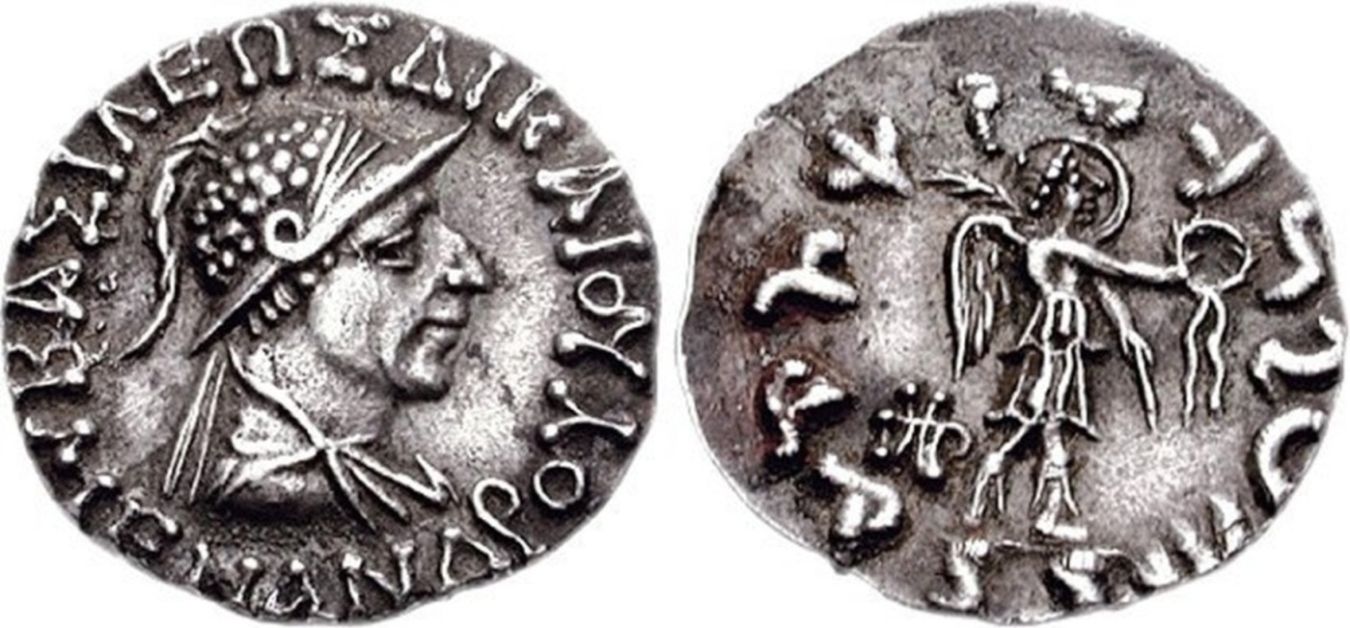
Such evidence confirms the intellectual bilingualism of the Yavana satraps, who knew both Greek and Sanskrit. Around 149 CE (Śaka 71), Yavaneśvara, a Yavana ruler, translated a Hellenic astrological treatise into Sanskrit prose. In 269 CE (Śaka 191), Sphujidhvaja versified this translation as the Yavanajātaka (“Nativity of the Yavanas”). A related work, the Vṛddha Yavanajātaka, is attributed to Mīnarāja of Mīnanagara (modern Bharuch or Karachi).
Greek–Sanskrit Lexical Correspondences
| No. | Greek Term | Sanskrit in YJ | Meaning | |----|-------------|------------------|----------| | 1 | Kentron | Kendra | Angular House (1, 4, 7, 10) | | 2 | Trigonon | Trikoṇa | Trine House (1, 5, 9) | | 3 | Dekanos | Dreṣkāṇa | 10° divisions of a sign | | 4 | Epanaphora | Panaphara | Succedent House | | 5 | Apoklima | Apoklima | Cadent House | | 6 | Kenodromia | Kemadruma | Void of course Moon | | 7 | Sunaphe | Sunaphā | Lunar Yoga |
Though many technical terms were Greek in phonetic origin, the presence of Vedic deities such as Brahmā, Prajāpati, and Īśvara in the Yavanajātaka shows that the text was not purely Greek. Rather, it represented a syncretic Indo‑Yavana astrology, combining Greek structure with Indian cosmology.
4. Assimilation and the Birth of Rāśi Astrology
The Sanskritized Yavanajātaka was quickly embraced by Indian scholars of the western regions. Its 12‑sign (Rāśi) Zodiac, now overlaid with Vedic gods, appeared to the pundits as a recovered form of “ancient Ārya knowledge.” Integrating it with Nakṣatra astrology, they developed new predictive systems such as the 120‑year Viṃśottarī Daśā.
Endorsed by authorities like Vṛddha Garga (252 CE) of Ujjain, the Yavana framework spread across India. Thus emerged Rāśi Astrology, the hybrid system still practiced today.
5. From Hipparchus to Siddhānta - Data & Computation
The Yavanajātaka mentions a Yuga of 165 years, evidently echoing Hipparchus’s “2° shift in 166 years” precessional observation (130 BCE). Although this cycle was never adopted in India, the astronomical data of Hipparchus - including his star catalog, trigonometric tables, and eclipse records - reached Indian centers such as Ujjain.
Combining this material with indigenous cyclic theory, Indian astronomers created the Siddhānta corpus - formal computational astronomy. Key works included:
- Paitāmaha Siddhānta
- Vasiṣṭha Siddhānta
- Romaka Siddhānta
- Pauliśa Siddhānta
- Sūrya Siddhānta
The Siddhānta period (~250–1150 CE) marked the shift from observational to computational astronomy. Figures like Āryabhaṭṭa (I) redefined the Mahā‑Yuga to fit their epicyclic planetary periods, proposing a Kali Yuga of 432,000 years. Āryabhaṭṭa introduced the 7‑day week and 24‑hour day division, replacing the older Vedic fortnight and Muhūrta system.
> Āryabhaṭṭa (Āryabhaṭṭīyam 3.15–3.16): > “Beneath the asterisms lie Saturn, Jupiter, the Sun, Venus, Mercury, and the Moon… > The seven planets beginning with Saturn rule the successive hours; every fourth becomes the lord of the next day.”
Before this reform, each day was ruled by the deity of its presiding Nakṣatra - a system that also reinforced Nakṣatra memory among the populace.
6. Decline of the Vedic Calendar and Rise of Ayanāṃśa Systems
The Lahiri Commission (1950s) adopted “the beginning of Aries rises when Spica sets” - Hipparchus’s 130 BCE definition - as the reference for the fixed Zodiac. Its resulting Lahiri Citrapakṣa Ayanāṃśa (epoch 285 CE) assumes linear precession, leading to a ≈ 1.5° offset today. The True Citrapakṣa Ayanāṃśa, correcting for this, is now the most widely used. Nevertheless, both share the same underlying Greek definition, showing the long‑lasting influence of the Hellenistic standard.
7. Scholarly Perspectives and Modern Critique
The 20th‑century historian David Pingree analyzed Indian astronomy extensively, though often attributing excessive Greek or Babylonian primacy. In his papers "Astronomy and Astrology in India and Iran" (1963) and "The Recovery of Early Greek Astronomy from India" (1976), he recognized the integration of Greek data into Siddhānta models but underestimated India’s prior Vedic astronomical foundation and indigenous cyclic frameworks.
> “Babylonian influence in astrology was equally great; in fact, the planets first appear in Indian literature because of it.” - Pingree (1963) > “This Kalpa of ultimately Babylonian origin was combined by Indian astronomers of the late fourth or early fifth centuries with Greek epicyclic theory.” - Pingree (1963)
Modern evidence from Vedic sources and Nakṣatra astronomy contradicts this reductionist view, revealing that India’s astronomical culture was already mature before these transmissions.
8. Summary of Evolutionary Stages
Vedic Observational Era
- 4174 BCE – 500 BCE
- 27/28 Nakṣatrā • Mahā-Yuga cycles • Non-computational astronomy
→ Empirical celestial observation
Cross-Cultural Era (Yavana–Śaka)
- 500 BCE – 300 CE
- Greek contacts • Yavanajātaka • 12-sign Zodiac • Horā division
→ Birth of Rāśi Astrology
Siddhānta Computational Era
- 250 CE – 1150 CE
- Epicyclic models • Āryabhaṭṭa’s reform • Trigonometry
→ Formalized planetary theory
9. References & Notes
- "The Science of Time and Timeline of World History", 2017
1. Lineage of Yayāti and Turvasu – See Purāṇic genealogies. 2. Shāhbāzgarhi Rock Edict 13 (Aśoka, ~250 BCE) refers to Antiochus as “Amtiyoko nāma Yonarāja.” 3. Geographia, Book 7, Ptolemy. 4. Yavanajātaka, 79.62 – Sphujidhvaja’s statement of versification. 5. Sūrya Siddhānta – Acknowledgment of knowledge transmission from Māyāsura to Yavanā. 6. Yavanajātaka, 79.3 – Mentions a 165‑year Yuga “according to the best of the Yavanā.” 7. Viṣṇu Purāṇa, 2.8.67–68 – Mentions equinox and solstice concepts in later insertions. 8. Pingree, D. (1963). “Astronomy and Astrology in India and Iran.” Isis, 54(2), 229‑246. 9. Pingree, D. (1976). “The Recovery of Early Greek Astronomy from India.” Journal for the History of Astronomy, 7(2), 109‑123.