Vṛddha Garga and the First Kali-Yuga Saṃvat
Abstract - The constellation of Ursa Major, revered in India as the Saptaṛṣi or "Seven Sages," became the cornerstone of ancient time-reckoning. From the conception of Saptaṛṣi Cycle to the founding of the First Kali-Yuga Saṃvat by Vṛddha Garga, this article traces how a celestial misinterpretation turned into the epochal definition of the very first Kali-Yuga epoch.
1. Introduction: The Seven Sages
In India, the constellation of Ursa Major (Great Bear) is known as the Saptaṛṣi (lit. "Seven Sages"). About this group of seven stars, named after seven great sages and seers of Vedic India: Marīci, Vasiṣṭha (+ Arundhatī), Aṅgirasa, Atri, Pulastya, Pulaha and Krātu, it was theorized by someone in Purāṇic India that they stay in every Nakṣatra (lunar asterism) for a 100 years and thus an utterly preposterous and fallacious Saptaṛṣi Cycle of 2700 years was interpolated in the Purāṇas in the name of these great sages.
!Chart Figure 1.17 - Saptaṛṣi pointing to Maghā Nakṣatra (Q3 Projection)
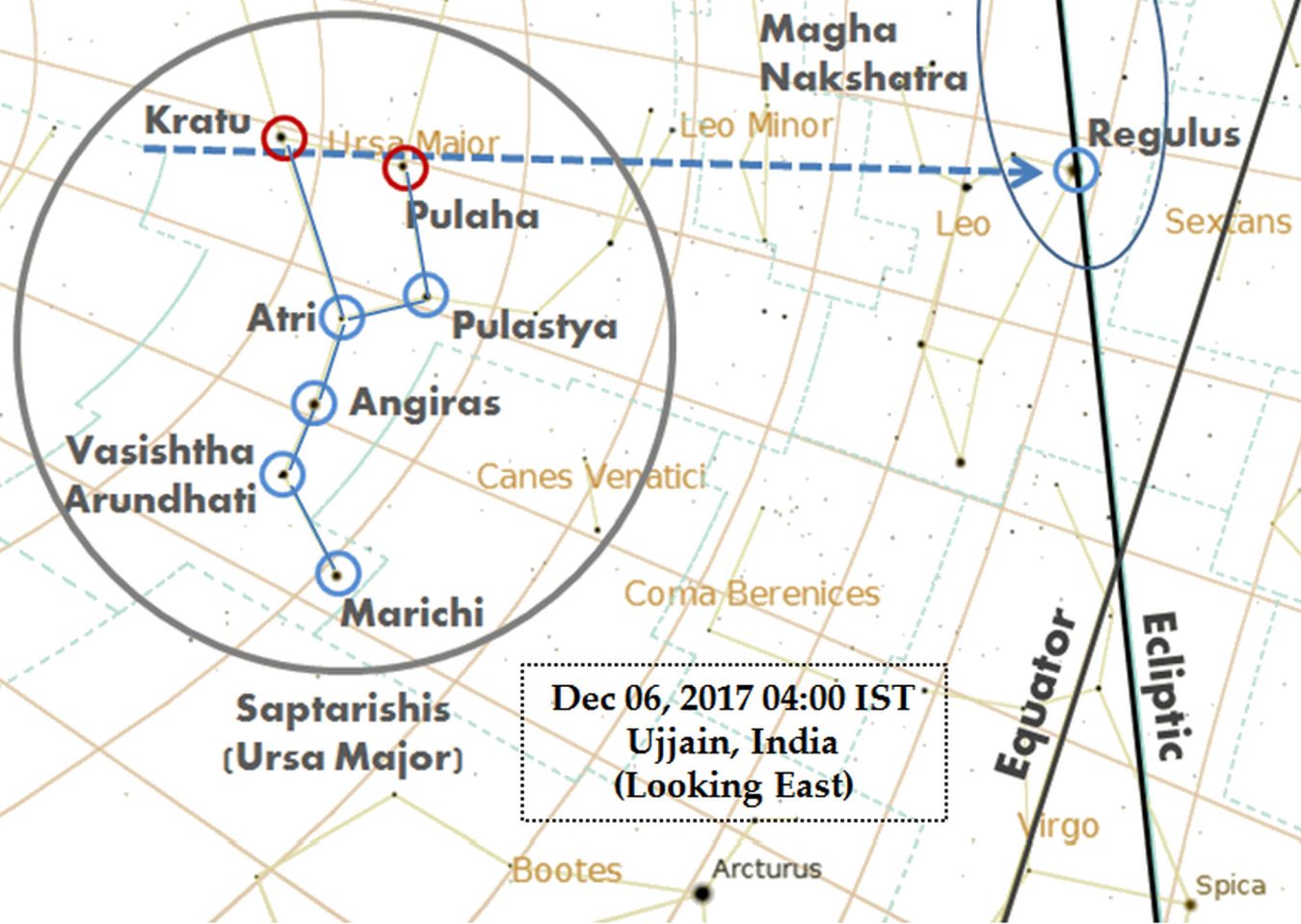
Observation Method: The correct method for observing the Saptaṛṣi is provided in the Viṣṇu Purāṇa (4.105-106) [3]: "Of the Seven Sages, two stars are first seen rising in the sky; through their midpoint lies the Nakṣatra that is seen at equal height at night. With that Nakṣatra they remain for 100 years of men."
Practically, this meant standing facing east during their rise and tracing a line from the middle of the top two stars (Krātu and Pulaha). This line intersects the ecliptic near Regulus (α Leonis) - the bright star in Q3 of Maghā Nakṣatra. Hence, in every era, the Seven Sages "point" to the same place, explaining the perceived fixity.
2. Origin of the Misinterpretation
The concept of the Saptaṛṣi Cycle arose from a Purāṇic Misinterpretation. Ancient observers noted that during King Parīkṣit's ascension (shortly after the Mahābhārata War), the Saptaṛṣi pointer indicated the start of Maghā Nakṣatra. A century later, seeing them still pointing to Maghā, observers erroneously concluded they had now moved to the "end" of Maghā - inferring that the stars traverse each Nakṣatra in 100 years. This led to the invention of the fallacious 2700-year cycle (27 Nakṣatras × 100 years each).
However, as we know scientifically, the Saptaṛṣi are essentially fixed with respect to the ecliptic, always pointing to Maghā Nakṣatra (Q3). The perceived cycle was entirely a geometric illusion.
3. Vṛddha Garga's Chronological Framework (252 CE)
Vṛddha Garga ("Garga Senior") of Ujjain, at the end of 252 CE, adopted this Saptaṛṣi Cycle to establish the first systematic Kali-Yuga chronology. When he reobserved the Saptaṛṣi and found them pointing to Maghā - exactly where they had been seen during Yudhiṣṭhira's time - he concluded that the 2700-year cycle had "restarted".
This is attested to by Varāhamihira who, in his Bṛhat-Saṃhitā (13.1-6), mentions the opinion of Vṛddha Garga to be as follows: > "The Seven Sages were in Maghā Nakṣatra when King Yudhiṣṭhira ruled the Earth; add 2526 to the Śaka years expired to find his year. They stay in each Nakṣatra for 100 years." [1]
From this, he back-calculated the Kali-Yuga epoch:
- Vṛddha Garga's observation: 252 CE (Saptaṛṣi at Maghā again)
- Cycle duration: 2700 years
- Calculated epoch: 252 CE − 2700 = 2448 BCE
Alternatively, using Śaka Era (78 CE): 78 CE − 2526 years = 2448 BCE.
4. Confirmation from Later Sources
Vṛddha Garga's dating is confirmed by Al-Bīrūnī (1031 CE) [2], who documented from a Kashmir almanac that the Saptaṛṣi had completed 77 years in Anurādhā Nakṣatra during Śaka 951 (1029 CE). This aligns precisely with Vṛddha Garga's system and confirms his epoch within a century.
Al-Bīrūnī himself noted the uncertainty: "Let us suppose that Garga is right, though he has not stated the precise place in Maghā which the Seven Rishis occupy". [2] This acknowledgment highlights the interpretive challenges even ancient scholars recognized.
5. Legacy and Influence
The Kali-Yuga Saṃvat #1 (Ujjain School) with epoch 2448 BCE became the canonical chronological system for Ujjain's astronomical tradition. It was widely referenced by later astronomers including Varāhamihira and influenced astronomical works, inscriptions, and historical records across India for centuries.
This epoch represents the first systematic attempt to establish a comprehensive chronological framework based on astronomical observation - even if that observation was based on a geometric misinterpretation. The Ujjain tradition's influence demonstrates how astronomical frameworks, even when astronomically invalid, can become enduring cultural and scientific anchors.
6. The Vikrama Saṃvat Misattribution
A significant consequence of this Ujjain school epoch occurred with the Vikrama Saṃvat. The famous court-poet Kālidāsa of Ujjain, serving under emperor Harṣa Vardhana Vikramāditya (592-647 CE), recorded in his work Jyotirvidābhāraṇa that the emperor ascended to the throne of Ujjain in 598 CE after completing his 6-year Digvijaya (conquest of the quarters) across North India. Kālidāsa expressed this timing as elapsed years of Kali-Yuga.
Since Kālidāsa belonged to the Ujjain school, his Kali-Yuga reference was naturally based on Vṛddha Garga's epoch (2448 BCE). However, the later scholars, unfamiliar with this distinction, erroneously interpreted Kālidāsa's figure using Āryabhaṭṭa's Kali-Yuga epoch (3102 BCE) instead - a difference of 654 years (3102 − 2448).
This misinterpretation shifted the Vikrama Saṃvat epoch backward by 654 years, from its true date of 598 CE to the commonly cited but incorrect date of 57 BCE. Thus, an error in epoch reference transformed a 7th-century CE commemoration into a supposed 1st-century BCE era - a testament to how crucial proper epoch identification is in historical chronology.
For a comprehensive listing of Indian eras and their correct epochs, see the companion article: Common Indian Eras (Saṃvat) And Their Epochs.
7. Conclusions
Vṛddha Garga's establishment of the 2448 BCE epoch marks an important transition from intuitive sky observation to systematic chronology in ancient India. Though the Saptaṛṣi Cycle was based on a geometric illusion - mistaking the stars' fixed pointing to Maghā for a 2700-year precessional movement - his methodical approach created a lasting framework that influenced Indian astronomical tradition for centuries.
This first Kali-Yuga Saṃvat laid the groundwork for subsequent epochs and demonstrates how observational astronomy, even when misinterpreted, can become a powerful tool for historical and astronomical computation. The Ujjain school's work illustrates the evolution of Indian astronomical thought from sacred sky-watching to mathematical time-reckoning.
9. References and Notes
- "The Science of Time and Timeline of World History", 2017
1. Varāhamihira, Bṛhat-Saṃhitā, 13.1-6 - Citations of Vṛddha Garga's statement on the Saptaṛṣi Cycle. 2. Al-Bīrūnī, Kitāb al-Hind ("Alberuni's India", 1910, Kegan Paul) Vol. 1, Chap. XLV pp. 391-393. 3. Viṣṇu Purāṇa, 4.105-106 - Method of Saptaṛṣi observation and its correlation with Maghā Nakṣatra. 4. Tilak, B.G., The Orion (1893) - Mentions the Saptaṛṣi being fixed relative to Nakṣatra zones. 5. Sule et al., "On the Sapta Rishi Cycle", Journal of Astronomical History and Heritage (2007). 6. Āryabhaṭṭa, Āryabhaṭṭīyam, III.15-16 - Adoption of 7 weekdays and 24-hour day.