The Kali-Yuga Epoch Riddle: How Two Epochs Created a Millennium of Confusion
Abstract - Two competing systems of cosmic chronology emerged in classical India, each defining the beginning of the Kali-Yuga differently. Vṛddha Garga's observational approach placed it at 2448 BCE, while Āryabhaṭṭa's mathematical framework set it at 3102 BCE - a difference of 654 years. This divergence created lasting confusion in Indian chronology, most notably transforming the 7th-century CE Vikrama Saṃvat into a supposed 1st-century BCE era. This article traces the origin of both epochs, examines how their coexistence created historical ambiguities, and reveals the chain of astronomical misconceptions that bridges observational Vedic astronomy with computational Siddhāntic tradition.
1. The Two Kali-Yuga Epochs: A Tale of Two Systems
In Indian astronomical tradition, two fundamentally different Kali-Yuga epochs emerged within 250 years of each other, each representing a distinct philosophical approach to celestial time-reckoning:
Kali-Yuga Saṃvat #1 (Ujjain School): 2448 BCE
- Established by: Vṛddha Garga, circa 252 CE
- Method: Observational - based on Saptaṛṣi (Ursa Major) pointer to Maghā Nakṣatra
- Duration: 2700-year Saptaṛṣi Cycle (27 Nakṣatras × 100 years each)
- Philosophy: Sky observation and visible celestial markers
Kali-Yuga Saṃvat #2 (Āryabhaṭṭa/Siddhāntic School): 3102 BCE
- Established by: Āryabhaṭṭa, 499 CE (age 23)
- Method: Computational - mathematical back-calculation
- Duration: 432,000 years (1200 divine years × 360)
- Philosophy: Mathematical abstraction and planetary period calculations
The Divergence: 654 years (3102 − 2448)
This seemingly technical difference had profound consequences for Indian historical chronology, astronomy, and even cultural identity - consequences that persist to the present day.
2. Vṛddha Garga's Observational System (2448 BCE)
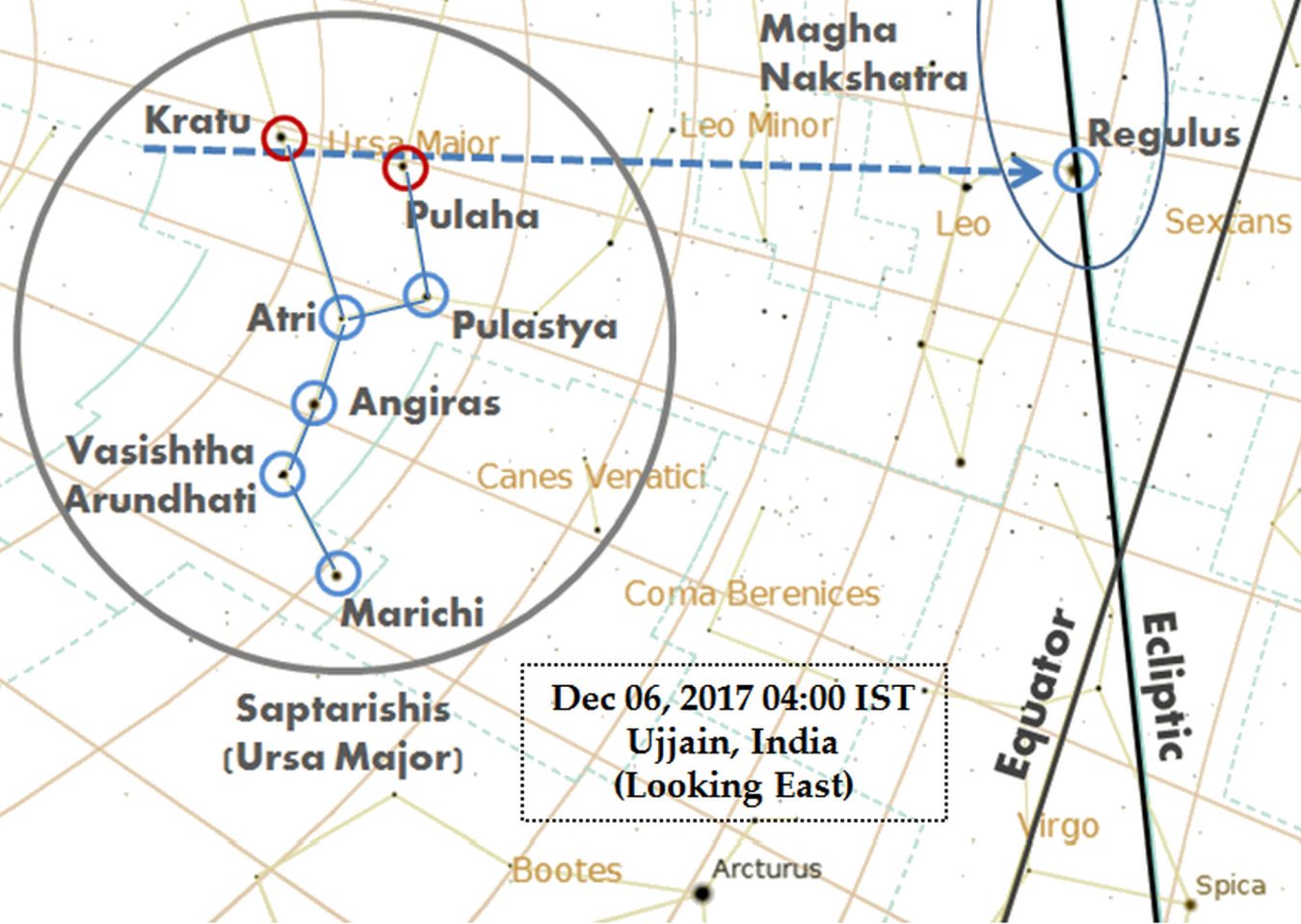
Around 252 CE, Vṛddha Garga of Ujjain observed the Saptaṛṣi (Ursa Major) pointing toward Maghā Nakṣatra. Based on Purāṇic tradition that these stars move from Nakṣatra to Nakṣatra every 100 years, he theorized they had completed a 2700-year cycle (27 Nakṣatras × 100 years) and back-calculated the Kali-Yuga epoch to 2448 BCE.
The Geometric Illusion: Modern simulations reveal the Saptaṛṣi pointer is essentially fixed relative to the ecliptic, always pointing to Regulus (α Leonis) in Q3 of Maghā. The "cycle" was a misinterpretation of repeated observations showing the same configuration.
!Saptaṛṣi pointing to Maghā Figure: Saptaṛṣi pointing to Maghā Nakṣatra (Q3 Projection)
For detailed analysis, see: Vṛddha Garga and the First Kali-Yuga Saṃvat.
3. Āryabhaṭṭa's Mathematical Revolution (3102 BCE)
In 499 CE, the 23-year-old Āryabhaṭṭa of Pāṭaliputra, lacking traditional tutelage but armed with Greek astronomical texts, faced contradictions the Ujjain system couldn't resolve. His radical solution: reinterpret Kali-Yuga's 1200 years as "divine years" and multiply by 360:
1200 × 360 = 432,000 years
Then back-calculate: 499 CE − 3600 years = 3102 BCE
This purely mathematical framework transformed Kali-Yuga from historical period to cosmic epoch. By the Sūrya Siddhānta (circa 505 CE), Āryabhaṭṭa's 3102 BCE epoch had supplanted Vṛddha Garga's system, becoming the Siddhāntic standard.
For detailed analysis, see: Āryabhaṭṭa and the Second Kali-Yuga Saṃvat.
4. The Vikrama Saṃvat Puzzle: A 654-Year Error
The coexistence of two Kali-Yuga epochs created critical ambiguities in interpreting historical records. The most consequential error occurred with the Vikrama Saṃvat, demonstrating how epoch confusion can transform historical reality into legend.
The Historical Event
In 598 CE, emperor Harṣa Vardhana Vikramāditya (592-647 CE) ascended to the throne of Ujjain after completing his 6-year Digvijaya (conquest of the quarters) across North India. His famous court-poet Kālidāsa, belonging to the Ujjain school, recorded this event in Jyotirvidābhāraṇa using Kali-Yuga elapsed years as his reference.
The Misinterpretation
Since Kālidāsa was from the Ujjain school, his Kali-Yuga reference was naturally based on Vṛddha Garga's epoch (2448 BCE). However, later astronomers and historians, unfamiliar with this distinction and using Āryabhaṭṭa's epoch (3102 BCE) as their standard, misinterpreted his chronological reference.
The Error:
- Kālidāsa's reference: Based on Ujjain Kali-Yuga (2448 BCE)
- Later interpretation: Assumed Āryabhaṭṭa's Kali-Yuga (3102 BCE)
- Epoch difference: 3102 − 2448 = 654 years
- Result: 598 CE was erroneously backdated to 57 BCE
The Consequence
This 654-year error transformed a 7th-century CE historical event - the ascension of a well-documented emperor - into a supposed 1st-century BCE legend. The "Vikrama Saṃvat of 57 BCE" thus became enshrined in Indian tradition, while its true origin date of 598 CE was forgotten.
How the Error Spread
The Aihole inscription of Pulakeshin II (634 CE), dated both in Śaka era (Śaka 556) and Kali era (Kali 3735), reveals that Āryabhaṭṭa's Kali epoch (3102 BCE) was already prevalent in kingdoms south of Ujjain during Harṣa's own lifetime. The error spread northward to Ujjain within 100-150 years after Harṣa's death in 648 CE, as Āryabhaṭṭa's computational framework gradually supplanted the observational Ujjain tradition.
Fortunately, a peculiar circumstance prevented total historical chaos: the increased Vikrama year count and the 654-year backdating cancelled each other out, leaving most history recorded in Vikrama years relatively intact in terms of absolute CE dates.
The Correction Formula
To recover the true Vikrama year from any inscription stating a Vikrama year, one must account for the "Kali Epoch Error":
True Vikrama Year = Stated Vikrama Year − 654
For example:
- Dhinki Inscription: States Vikrama 794 (thought to be 738 CE = −56+794)
- True Vikrama year: 794 − 654 = 140
- Actual CE year: 598 + 140 = 738 CE (remains correct!)
Astronomical Verification: The Kundeshvara Inscription
The Kundeshvara Copper Plate Inscription (Vikrama 1060) at Tikamgarh (78.50°E, 24.44°N) specifies a solar eclipse on Śrāvaṇa Amāvasyā (New Moon). Applying the correction:
- Stated Vikrama year: 1060 (thought to be 1004 CE = −56+1060)
- True Vikrama year: 1060 − 654 = 406
- Actual CE year: 598 + 406 = 1004 CE (remains correct!)
According to the Vedic calendar, Śrāvaṇa Amāvasyā fell on July 20, 1004 CE, with solar eclipse maximum at 08:11 IST - perfectly matching the inscription! This confirms: 1. The correction formula is valid 2. The Vedic calendar was still being computed correctly in parts of India even in 1004 CE
Al-Bīrūnī's Evidence (1031 CE)
The Arab scholar Al-Bīrūnī, who documented Indian society in 1031 CE, provides crucial corroboration. He noted that some inhabitants told him of a Śrī-Harṣa era lying about 400 years before his time - clearly retaining memory of Harṣa Vardhana's reign (592-647 CE), even though the Vikrama era had become dissociated from his name due to the "Kali Epoch Error."
Intriguingly, Al-Bīrūnī mentions that a Kashmiri calendar stated the Śrī-Harṣa era lay about 664 years after the Vikrama epoch. This is precisely the Kashmiri pandits mistaking Vikrama to start at 57 BCE: −56 + 664 ≈ 608 ≈ 598 CE. Thus, the "Śrī-Harṣa era" mentioned by Al-Bīrūnī is none other than the true Vikrama era (598 CE) of Harṣa Vardhana himself.
Eras Noted by Al-Bīrūnī in 1031 CE
| Era Name | Era Year | Base Year (CE) | Corrected Base Year | |----------|----------|----------------|---------------------| | Yazdajird (current) | 400 | 632 | 632 | | Śaka (expired) | 953 | 78 | 78 | | Vallabhī/Gupta (expired) | 712 | 319 | 319 | | Vikrama (expired) | 1087 | −56 | 598 (−56+654) |
Note: Base Year = 1031 − (expired) Era Year; Corrected Base Year = Base Year + 654 for Vikrama only
The Veraval Inscription of Chalukya Arjunadeva (1263 CE) similarly lists years of Vikrama, Mohammed, and Vallabhī eras, providing further cross-verification of the epoch system.
This single misattribution demonstrates the profound consequences of epoch ambiguity in Indian chronology. It shows how a technical astronomical difference cascaded into fundamental historical confusion that persists to the present day - yet also how careful astronomical verification (eclipses, Nakṣatra positions, weekdays) can recover true chronology.
For comprehensive era listings, see: Common Indian Eras (Saṃvat) And Their Epochs.
5. The Three Successive Errors: Anatomy of the Riddle
The "Kali-Yuga Riddle" - the transformation from realistic historical periods to mythic cosmic time - arose from a chain of three successive astronomical misconceptions:
Error #1: The Saptaṛṣi Precessional Illusion
Ancient observers noted that the Saptaṛṣi constellation pointed toward Maghā Nakṣatra. When observers a century later saw the same configuration, they concluded the stars "move" from Nakṣatra to Nakṣatra every 100 years. This was a misreading of a visual coincidence as astronomical precession.
Reality: The Saptaṛṣi pointer is essentially fixed relative to the ecliptic due to the stars' extreme distance and slow proper motion. The line from the two upper stars (Krātu and Pulaha) always intersects the ecliptic near Regulus (α Leonis) in Q3 of Maghā.
Consequence: The invention of a 2700-year "Saptaṛṣi Cycle" (27 Nakṣatras × 100 years).
Error #2: Mistaking a Visual Cycle for Cosmic Chronology
Vṛddha Garga, observing the Saptaṛṣi at Maghā in 252 CE and believing the supposed 2700-year cycle had completed, back-calculated the Kali-Yuga epoch to 2448 BCE. This was mistaking a geometric illusion for a cosmic period.
Reality: The "cycle completion" was simply another observation of the permanently fixed Saptaṛṣi-Maghā alignment. No actual cycle had occurred.
Consequence: Establishment of the first Kali-Yuga epoch (2448 BCE) based on a non-existent astronomical phenomenon.
Error #3: Expanding Symbolic Time into Mathematical Infinity
Āryabhaṭṭa, unable to reconcile the Ujjain system's contradictions, reinterpreted the Kali-Yuga's 1200 years as "divine years" and multiplied by 360. This was expanding a symbolic period into 432,000 mathematical years.
Reality: The 1200-year Kali-Yuga was likely a conventional or symbolic period in earlier Vedic tradition, not meant to be multiplied into cosmic timescales.
Consequence: Transformation of Kali-Yuga from a manageable historical epoch into an incomprehensibly vast cosmic age, severing astronomy from its observational roots.
6. The Eternal Kali-Yuga: Modern Implications
The adoption of Āryabhaṭṭa's 432,000-year Kali-Yuga created a "dark age" that, for all practical human purposes, is eternal.
Current Status (as of 2025 CE):
- Elapsed Kali years: ~5,126 (using 3102 BCE epoch)
- Remaining Kali years: ~426,874
- Progress: ~1.2% complete
- Estimated end: ~427,000 CE
This temporal framework has had profound cultural and psychological impacts:
1. Historical Pessimism: The belief in being trapped in an endless dark age has influenced Indian cultural attitudes toward progress and time itself.
2. Chronological Confusion: The coexistence of two epoch systems (even after Āryabhaṭṭa's dominance) created lasting ambiguities in historical dating, as evidenced by the Vikrama Saṃvat error.
3. Astronomical Abstraction: The shift from observation-based to computation-based astronomy enabled sophisticated planetary calculations but disconnected timekeeping from visible celestial phenomena.
4. Cultural Persistence: Even today, most Indians believe in the 432,000-year Kali-Yuga, unaware of its 5th-century CE mathematical origin or the earlier observational system it replaced.
7. Conclusions and Insights
The Kali-Yuga Riddle encapsulates one of the most fascinating transformations in astronomical history - from observable sky phenomena to abstract mathematical time. This transformation occurred through a chain of well-intentioned but ultimately flawed interpretations:
Vṛddha Garga's Contribution: An honest attempt to establish cosmic chronology through systematic observation. Though based on a geometric illusion (the fixed Saptaṛṣi pointer), his 2448 BCE epoch served the Ujjain school well for centuries and demonstrates the power of observational tradition.
Āryabhaṭṭa's Revolution: A brilliant mathematical rationalization that solved computational problems but severed astronomy from its observational roots. His 3102 BCE epoch and 432,000-year duration created an "eternal Kali-Yuga" that transformed Indian cultural attitudes toward time itself.
The Lasting Legacy: Together, these two systems illustrate the continuum of Indian astronomical thought - from sacred geometry and sky observation to pure mathematical computation. Their coexistence created the "riddle": a 654-year gap that confused historical chronology (as in the Vikrama Saṃvat error) while simultaneously enabling both observational tradition and computational sophistication to flourish.
Modern Perspective: The Kali-Yuga Riddle reminds us that astronomical systems are human constructs, subject to the limitations and assumptions of their creators. What began as a misreading of the Saptaṛṣi's apparent motion evolved into a cosmic framework that has shaped Indian civilization's conception of time for over 1,500 years.
Understanding this riddle helps us appreciate:
- The transition from observational to mathematical astronomy
- How technical errors can cascade into cultural beliefs
- The importance of proper epoch identification in historical chronology
- Why critical examination of traditional systems, however venerated, remains essential
The stars of Maghā still shine where the Saptaṛṣi have always pointed - but the epochs we derive from them reveal more about human interpretation than cosmic truth.
A Cautionary Note on Historical Chronology
It's imperative to mention that some modern revisionist attempts to "correct" Indian chronology have created far greater confusion than the original epoch error. Notable among these are the theories of south Indian monk Kota Venkatachalam (1885-1959 CE), whose followers shift the entire historical timeline of India by many centuries.
These revisionists, claiming Indian history is a "Victim of Concoctions and Distortions" by "Biased Western Historians," demonstrate poor understanding of both history and science. They reject well-established key dates such as:
- Buddha (563-483 BCE)
- Chandragupta Maurya (321 BCE)
More egregiously, they shift the epoch years of unassailable eras:
- Śaka era (78 CE) → shifted arbitrarily
- Gupta era (319 CE) → shifted arbitrarily
These epoch years have been tested and verified through: 1. Historical cross-references (relative chronology from inscriptions, coins, foreign accounts) 2. Calendrical parameters (eclipses, Nakṣatra positions, weekdays) 3. Archaeological evidence (stratigraphy, pottery sequences, radiocarbon dating)
While some imperial-era scholars like Max Müller may have shown bias, the wholesale rejection of established chronology based on misunderstanding the "Kali Epoch Error" is intellectually untenable. The proper approach is what we've demonstrated here: understanding the astronomical basis of the epoch systems and applying appropriate corrections where needed, not arbitrarily shifting entire chronological frameworks.
8. References and Notes
- "The Science of Time and Timeline of World History", 2017
1. Varāhamihira, Bṛhat-Saṃhitā, 13.1-6 - Citations of Vṛddha Garga's statement on the Saptaṛṣi Cycle. 2. Al-Bīrūnī, Kitāb al-Hind ("Alberuni's India", 1910, Kegan Paul) Vol. 1, Chap. XLV pp. 391-393 - Kashmir almanac observations and eras in use circa 1031 CE. 3. Viṣṇu Purāṇa, 4.105-106 - Method of Saptaṛṣi observation and correlation with Maghā Nakṣatra. 4. Āryabhaṭṭa, Āryabhaṭṭīyam (499 CE) - Establishment of 3102 BCE epoch and 432,000-year Kali-Yuga. 5. Sūrya Siddhānta (circa 505 CE) - Adoption of Āryabhaṭṭa's epoch as Siddhāntic standard. 6. Kālidāsa, Jyotirvidābhāraṇa - Records Vikrama Saṃvat using Ujjain school chronology. 7. Aihole Inscription of Pulakeshin II (634 CE) - Dual dating in Śaka and Kali eras, demonstrating spread of Āryabhaṭṭa's epoch. 8. Dhinki Inscription (Vikrama 794 = 738 CE) - Earliest explicit use of Vikrama Saṃvat. 9. Kundeshvara Copper Plate Inscription (Vikrama 1060 = 1004 CE) - Solar eclipse verification on Śrāvaṇa Amāvasyā. 10. Veraval Inscription of Chalukya Arjunadeva (1263 CE) - Lists Vikrama, Mohammed, and Vallabhī eras. 11. Fleet, J.F., Corpus Inscriptionum Indicarum (CII), Vol. VII - Compilation of Indian inscriptions with epoch analysis. 12. Sule et al., "On the Sapta Rishi Cycle", Journal of Astronomical History and Heritage (2007). 13. Tilak, B.G., The Orion (1893) - Analysis of Saptaṛṣi fixity relative to Nakṣatra zones.